
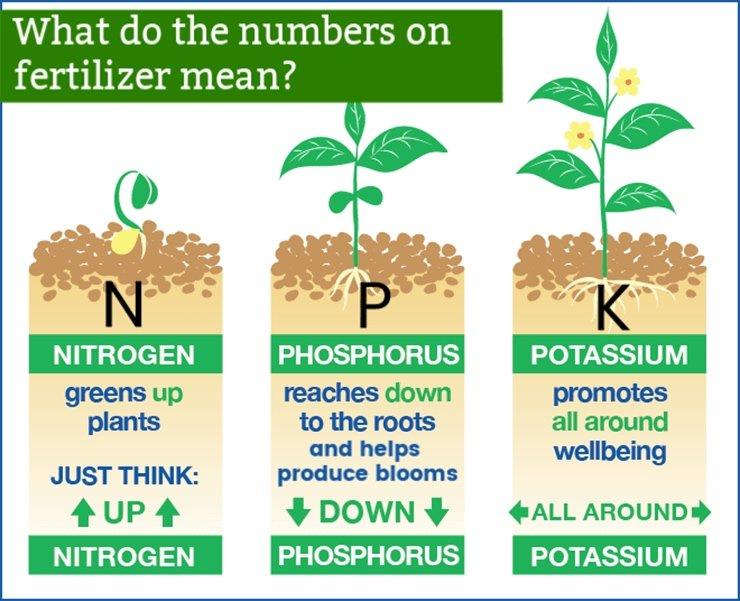
N-P-K refers to three major nutrients commonly supplied through fertilizers: Nitrogen (N), Phosphorus (P), and Potassium (K). These nutrients play important roles in plant growth and development.
N — Nitrogen
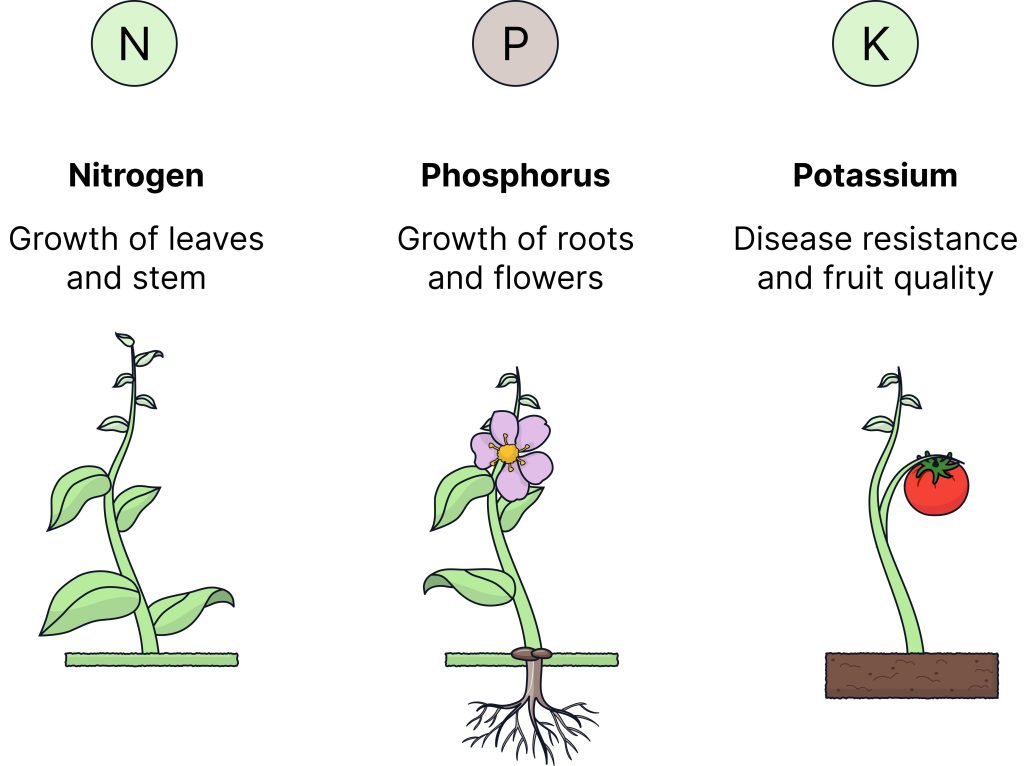
Nitrogen plays an important role in vegetative growth, particularly the development of leaves and stems. It is also an essential component of chlorophyll and proteins.
Plants deficient in nitrogen may develop pale or yellowing leaves, particularly older leaves, and may show reduced growth.
N supports: Vegetative growth, leaf development, and chlorophyll production.
P — Phosphorus
Phosphorus plays an important role in root development and is involved in flowering and fruit development.
Phosphorus deficiency may result in slow growth and reduced flowering or fruit production.
P supports: Root development, flowering, and fruit development.
K — Potassium
Potassium is involved in many essential physiological processes within plants. It also helps plants tolerate environmental stresses such as drought and temperature extremes and contributes to overall plant performance and crop development.
K supports: Plant resilience, stress tolerance, and crop development.
How to Read an N-P-K Fertilizer Label
Fertilizer labels commonly display three numbers, such as 15-15-15 or 13-13-21.
These numbers are listed in the order N-P-K.
For example:
15-15-15
means the fertilizer contains:
- 15% Nitrogen (N)
- 15% Phosphate (P₂O₅)
- 15% Potash (K₂O)
Therefore, a 100 kg quantity of 15-15-15 fertilizer contains 15 kg of nitrogen, while the phosphorus and potassium values are expressed according to the conventional P₂O₅ and K₂O labeling system.